Thermal inspection for solar fields and rooftops
A panel that stops producing doesn't announce it. A radiometric thermal scan from the air finds, within hours, every place where the system is losing power, in a field or on a roof, and maps each finding to its place on site, so the maintenance team goes out with a list, not a search.
What is it costing you? Try the calculator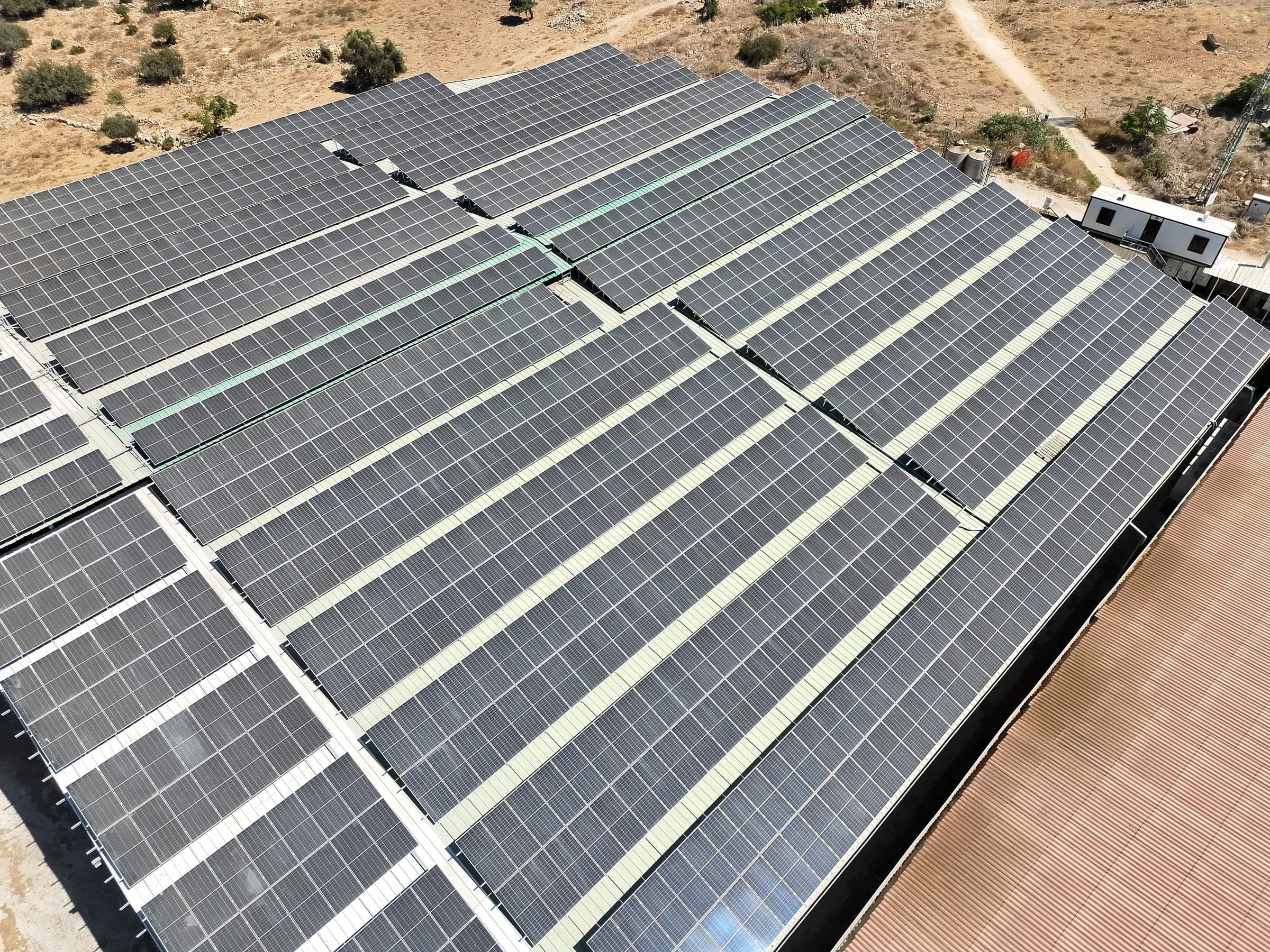
A panel that isn't producing heats up
A solar panel turns part of the sunlight into electricity and the rest into heat. When a cell, a panel or a whole string stops carrying current as it should, the energy that doesn't leave as electricity stays in the panel as heat, and the panel runs hotter than its neighbours.
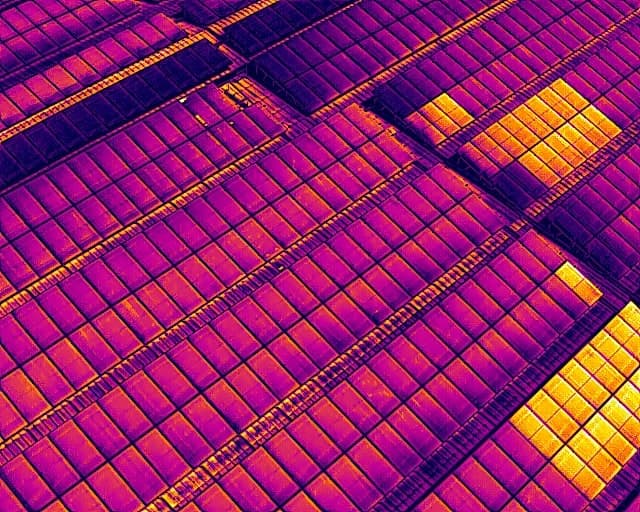
To the eye there's no difference: from above every panel looks the same. To a thermal camera the difference stands out at once. In this image most panels are an even purple, and a few groups glow yellow, hotter than the rows around them.
Abnormal heat is a sign of where to look, not a diagnosis. The survey marks every such area on the map, and your electrician or maintenance team checks on site what the cause is.
Heat patterns worth knowing
Each fault has its own shape in a thermal image. These are the common ones: what you see, and what it may mean. The cause is always settled by a check on site.
A single hot cell
One hot spot in a panel whose other cells are normal. Often a cracked cell, local dirt such as bird droppings, or the shadow of something close by.
A hot third of a panel
A hot strip along a third of the panel: the typical sign of a bypass diode cutting that group of cells out of the circuit.
A whole panel hot
A panel evenly hotter than its neighbours. Usually a panel that isn't connected to the circuit, for example because of a faulty connector.
A hot string
A run of hot panels along a whole string: the string is probably not producing, because of a fuse, a connector or an inverter input.
Soiling and shading
Hot areas in the pattern of dust, vegetation or a nearby structure. Not a fault in the panel itself, but lost production that can be prevented.
Broken glass or cells
A fragmented or web-like heat pattern, consistent with broken glass or cells, sometimes after hail or an impact.
Exactly what you get
A full radiometric thermal scan
Every panel in the field is captured in thermal and visible light, in absolute rather than relative temperature, so scans can be compared and degradation spotted over time.
Findings classified to IEC 62446‑3
Every anomaly is classified by type and severity: a single hot cell, a disconnected string, a faulty bypass diode, breakage, soiling or shading.
Mapped to panel and string
Each finding gets a row, string and panel number from the site plan, not just a mark on a picture. That's the difference between a report you can work from and an album.
Estimated power loss
The power actually lost from each group of findings, so you know what to fix first and what can wait for the next round.
4K video of the system
Alongside the thermal scan, we film the panels from the air in 4K. The video goes up to the client portal: watch it in the browser, or download the original file in full 4K.
How it's done
- 1
Booking the scan window
The scan is flown at irradiance of 600 W/m² and above, at hours when the thermal contrast is clear. We set the day and hour by the weather, not the calendar.
- 2
Autonomous flight
A path planned in advance at a fixed height gives full coverage and even overlap, with no missed areas and no difference in resolution across the field.
- 3
Processing and classification
The raw data goes through radiometric correction, stitching into an orthophoto and classification of findings, with a manual check of every severe finding.
- 4
Delivery in the portal
The report, the raw outputs and the 4K video go up to the client portal. Every finding is shown on the map with its thermal image, and the video can be watched in the browser or downloaded.
Deliverables
- PDF findings report
- CSV findings table
- Radiometric thermal R‑JPEG
- Orthophoto of the field
- 4K video of the system
- Mapped heat map
- GIS layer / KML
Who it's for
- Solar field developers and operators
- Operations and maintenance (O&M) companies
- Owners of commercial solar rooftops
- Lenders that require periodic inspection
Technical specification
- Thermal camera
- Radiometric 640×512
- Sensitivity (NETD)
- < 50 mK
- Ground resolution
- 3 cm per pixel
- Classification standard
- IEC 62446‑3
- Threshold
- Irradiance above 600 W/m²
What people ask us
Does the field need to be shut down during the scan?
No. The inspection is done while the field is producing; that is exactly what reveals the thermal differences. No production stop, no downtime.
How often should a site be inspected?
Once a year for a field in routine operation, plus a record of its condition before handover and before the manufacturer's warranty ends.
Does it work on rooftops too?
Yes. A rooftop system is scanned the same way as a field. The flight is coordinated in advance with the building's owner, subject to the flight permits the area requires.
What do you need from us before the survey?
The site's location, access on the day of the flight and, if you have one, the system plan with its row and string numbering, so each finding is mapped to its panel.
Can the report be submitted to the manufacturer under warranty?
Yes. Classification to IEC 62446‑3 and radiometric records are exactly what manufacturers ask for in a warranty claim.
Want a solar thermal inspection for your site?
Send us the site's location and what the inspection is for, and we'll come back with a quote and a flight date, usually the same business day.